Description
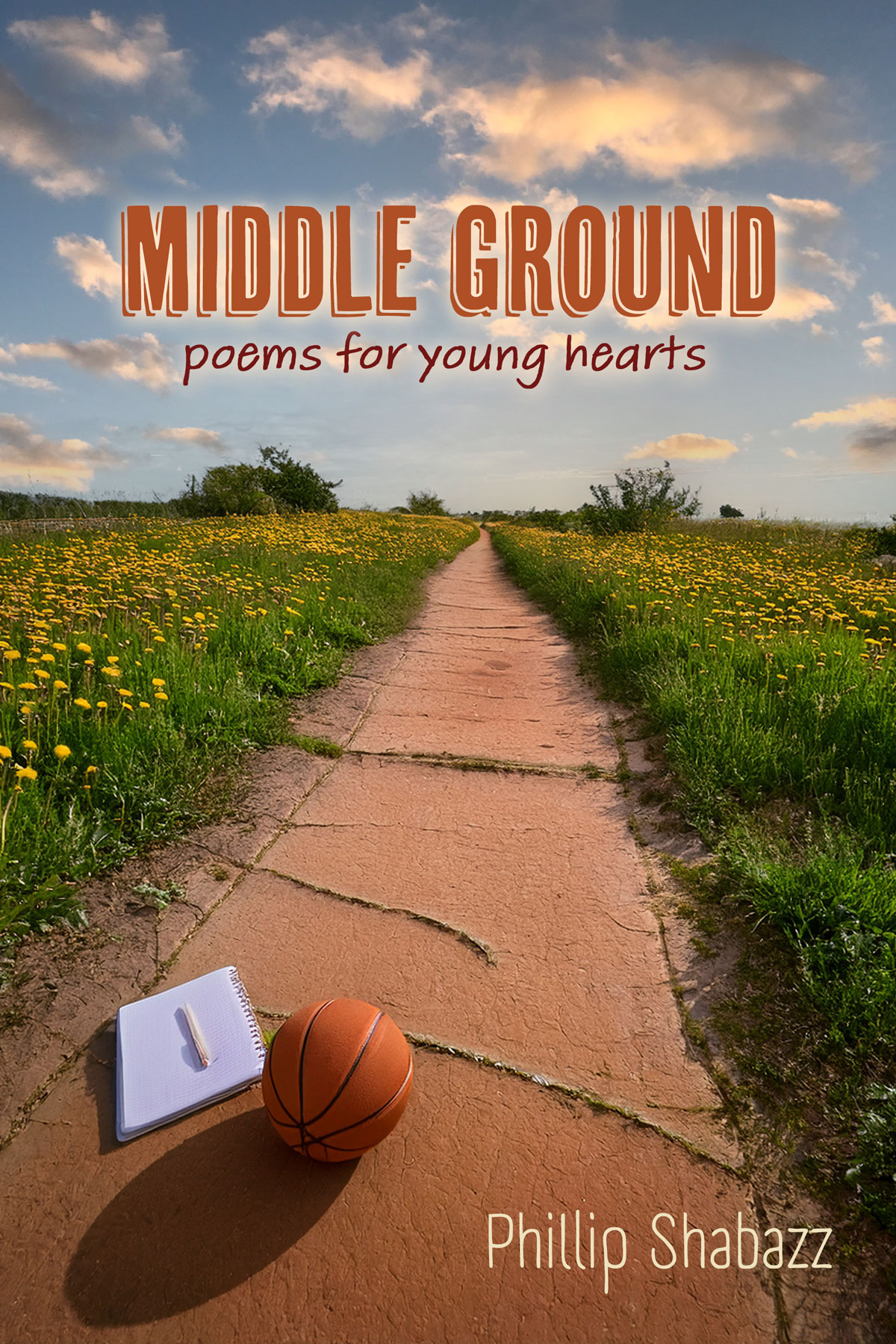
Middle Ground
Poems for Young Hearts
by Phillip Shabazz
Middle Ground is a 152-page poetry collection that traces the arc of adolescence through five seasonal chapters, speaking directly to the lived experiences of young people while maintaining poetic craft. Designed for middle and high school students as well as adult readers, the collection refuses to soften the realities of contemporary youth—economic hardship, systemic racism, gun violence, incarceration, mental health struggles—while insisting on beauty, resistance, and the possibility of transcendence.
Part One introduces young speakers discovering their voices, navigating family complexities, and establishing identity. Poems like “To Grandma” connect Harriet Tubman to chocolate cake, while “Father’s Day” confronts paternal absence with unflinching clarity. “Calculus of the Kitchen” and “Silk Scarf” address class and racial profiling. The chapter establishes the collection’s central tensions: belonging vs. alienation, safety vs. danger, inheritance vs. self-creation.
Part Two centers on summer’s openness—first love (“Puppy Love,” “First Kiss in Summer”), friendship, and loss. “The Day the Lake Stopped Singing” confronts drowning and grief. “For My Brother Back From Juvenile Lock Up” and “Welcome Home, Little Man” address incarceration’s impact on families. The chapter balances joy (skating rinks, swimming pools) with awareness that not everyone survives summer.
Part Three This chapter serves as the collection’s moral compass, rejecting easy binaries in favor of the complex, lived truth of the ‘middle ground’. It moves into autumn’s moral complexity. “Middle Ground” serves as the collection’s title poem and thematic anchor, arguing for the legitimacy of uncertainty and nuanced thinking. “What I Can’t Undo” and “The Secret I Buried” examine complicity in harm. “My Uncle’s Code” explores gang violence and loyalty. “Girl, Incarcerated” speaks to systemic injustice. The chapter refuses easy answers while insisting on accountability.
Part Four enters winter’s austerity. These poems confront survival, silence, systemic oppression, and the weight of history. “Tied To The Earth I & II” address racial identity and microaggressions. “The Ballad of Hollow-Eyed Joe” uses folklore to explore community memory. “Snowblind Silence” depicts domestic tension. “Wishes For You” offers benediction amid hardship. The chapter shows winter not just as season but as condition—economic, emotional, historical.
Part Five arrives at spring as both renewal and reckoning. “Car Windows Down” celebrates survival. “Ode For Frederick Douglass” positions literacy as insurrection. “Growth Hurts” acknowledges the pain of transformation. “Desired Ones: An Invocation” closes the collection by calling on ancestral powers, folk wisdom, and communal strength—”I call on all folk powers of super hearts and ghosts.”
Early Praise
In 100 uniquely executed poems, Phillip Shabazz captures the innocence and whims of youth to such a fine degree, both adolescents and their elders will find themselves on numerous pages. Flowing seamlessly through the seasons, Shabazz masterfully and metaphorically invites readers into a kaleidoscope of emotions and life experiences. Tender moments like first love, first paycheck, basketball finesse balance the harsh realities of family imprisonment, peer drowning, actualities of poverty. Through vivid and often unexpected imagery, Shabazz demonstrates keen mastery of the young adult psyche as it navigates life’s celebrations and sorrows.
—LINDA VIGEN PHILLIPS, author of Crazy
At the close of this new poetry collection offered especially to young readers, Shabazz calls out to all sources of his personal and cultural inspiration in this invocation: I call on Mother Earth, her gardens young and old to give us life, not too much strife, and books of tales twice told. In Middle Ground, Shabazz illuminates a young poet’s life into vivid episodes with quotes from the likes of Langston Hughes, Mary Oliver, Nikki Giovanni and the Bard himself, William Shakespeare, naming each epoch of influence. Within each section, the reader experiences how a poet’s heart learns to beat in rhythms of family, friends, young love, neighborhood, and culture. These poems take the reader to a sphere of experienced wonder where the streetlights were once galaxies and where: That tightness in your chest is your heart learning to hold more sky.
—ROBERTA SCHULTZ, author of Deep Ends
With rich rhymes, words selected to be slant and lyrical, Phillip Shabazz blazes through adolescence and young adulthood with both witness and balm. There are ghosts invented to explain the shape of my own jaw and mothers’ Sunday blouses, puppies and candy, and grit and grace, and please, can we please, find that Middle Ground he aspires to in this collection? Shabazz’ images are ethereal and ghostly, imprinting us with the grandmothers, grandfathers, uncles, mothers, fathers, school friends, and first loves… but it’s not just vivid and well-crafted reminiscence. These are poems of survival and aid; he tells us how the silence isn’t silent and the past doesn’t compress or disappear. Every closely chosen word is loose and tight at the same time, casual but packed with the might of image. This book is for those of us who’ve made it through, and especially for those still struggling, of any age.
—CHRISTINE ARDVIDSON, author of Nobody Cares What You Think

About the Author
Phillip Shabazz serves as a Poet-in-the-Schools of North Carolina and is the author of four poetry collections and two novels, including the coming-of-age novel Pearls In The Sea (2026). His most recent collection, Moonflower, is published by Fernwood Press (2025). His work has been nominated for Best of the Net and has been included in the anthologies Paul Green: North Carolina Writers on the Legacy of the State’s Most Celebrated Playwright, Crossing the Rift: North Carolina Poets on 9/11 & Its Aftermath, and Home Is Where: African American Poetry from the Carolinas. Some publication credits in journals include Fine Lines, Florida Review, Galway Review, BREATHE, Queen’s Quarterly, K’in, and Thimble.


Reviews
There are no reviews yet.